Wednesday, December 19, 2018

Expired Old folks and the rise of Nigerian counterculture


Theodore Roszak coined the term counterculture in 1968 to explain youthful opposition to older generation’s principles and approaches towards politics, education, the arts and social relations. Counterculture would eventually enter into world mainstream discourse as a term to describe similar oppositions to elitist, high modernist ideals. It was deployed majorly during American cold war era when liberal economies failed to salvage the post-world war decline, and also during the 1960s devastations ignited by the Vietnam War. Indeed the late 1960s saw increasing youthful opposition to the contested ideology of the old’s technocracy not just in the United States but all over the world. The 1960s was rocked by the American-Vietnam War, Civil Rights Protests, assassination of US President John F. Kennedy and Martin Luther King Jnr, the launching of the Cuban Missiles and many more. In Africa, it was marked by youthful agitations to take control of Africa’s leadership from the colonialists. Then, most of these old politicians were at their best and were in their 20s, 30s and 40s.
         The term counterculture befits Nigeria at this moment.  This is because Roszak proposed counterculture as a response to pervasive enemy of youth idiosyncrasy. Counterculture simply means the youth opposing the archaic, unrealizable, expired, unworkable ideas of the old generation. And this is what plays out, needs to play out, in Nigeria at the moment.
         To be clear, this is not an attempt to stereotype against the old generation. When I use ‘old generation’ I mean the same old politicians who have been hanging around in Africa since independence. They have orchestrated wars, exterminations, famines, genocides, ethnic cleansing, corruption, kleptocracy, name them. I mean the Mugabes, the Zumas, the Biyas, the Jamehs, the Omar Bongos, the Musevenis, the Dos Santos, the B…. The list is endless. All their supporters also belong to this old generation. If you qualify for youth category and you support them then you are an old generation. It means your ideas are old and expired. Common guys, these are expired old folks with expired brains. So they will continue to inject expired stuffs into your veins.  If the average age of the African continent is the 20s it means that more than 70 percent of Africans were not born when these bunch of leaders clung unto power.
       Counterculture will deliver you. It delivered Ethiopia where the young, dynamic, president has applied laxative to wash and set the engine of the Ethiopian nation. An inventory of some other African states suggest that the young generation performed better by washing and setting their nations.  Nigeria desperately needs counterculture to wash and set all the parts now. If you have once visited an Ogbonge herbalist you will understand the meaning of washing and setting. All the debilitating parts of Nigerian parts needs to be tumbled, dissected, rinsed with fuel or kerosene, or Ogbonge liquid, and set back.
       Oil and water can never mix. Old politicians and their supporters are mutually exclusive with rational youth idiosyncrasy. Old, expired, politicians are irreconcilable with vibrant, healthy youth aspirations. This is a case of apartheid versus anti-apartheid.  It is just an incongruity to think that old polit-trickians can deliver a young, novel idea. Imagine Mugabe reading an old state of the nation address to his parliament sometime without knowing it was an old address. What of Buhari who read a stolen address of Obama sometime without knowing, and who claimed ignorant of most happenings under his watch, prompting the wife to raise alarm that he is not in control.  
       Imagine. The Nigerian president calls the youth lazy.  Imagine losing 27 percent jobs that belong to the youth under one year. Yet most youth in Nigeria drive the small scale industry sector. In the music industry the Nigerian youth are world champions, recording most millionaires than every other Africa nation. By 2020 the Nigerian music industry is expected to generate 50 million US dollars. In the SMS businesses they drive the economy by thriving under a counterproductive economic environment provided by the clueless old politicians. It is obvious that the leadership of this nation can only succeed when counterculture reaches Abuja and drives away the old, expired cargoes, and sits on the exalted chair. New engine is better than old engine. Old engine breaks down every now and then. And sorry when the engine breaks down in the middle of nowhere, just as that of Nigeria has broken down in the middle of the desert.  
       The youth are the livewire of the Nigerian economy as they rebel against the high modernist economic policies that the old generation politicians invoke to deceive them. I give the youth of Nigeria credit because, judging from the rest of Africa, Nigeria ranks as the nation where youth hit the street and make it without depending on the non-existent government. So counterculture is constantly at work here. But the real counterculture would be when the youth march en masse to Aso Rock, bring down the engine, dissect it, wash it and then set it.


Saturday, December 8, 2018

As Mbaka apologizes, EFCC ‘Mene mene tekel Urphasin’ and touch not my anointed’.


EFCC should have learnt some lessons from the Mbaka’s episode. Mbaka seems to have tampered with the anointed son of God, Peter Obi. Mbaka’s disgrace of Obi on his alter at Adoration Prayer Ministry Enugu (AMEN) made Obi more popular and occasioned a Social Media war by Obi’s numerous fans against AMEN. It was as though the Social Media answereth by fire and Mbaka suffered the severe burn of the fire set at his video by the Social Media warlords. It seems Mbaka and other churches thought they were the only people who controlled the instrument of casting by ‘fire’. However, the ‘fire’ that the Social Media combatants spewed were burning Mbaka and AMEN. He quickly saved himself from the ravaging inferno which almost burnt down his video on the Social Media. He apologized.

By Apologizing at the same alter he ignominiously disparaged Obi, Mbaka exhibited a heroic Christian rectitude that suggested that he is still a true man of God. He has vindicated himself by clearing the skepticism of many who doubted his calling as a man of God. He also realized how he worked against the prophetic statement: ‘touch not my anointed Obi and my prophet Obi do no harm”. This is the story of Peter Obi.

This story commenced when Mr Peter Obi won the governorship election of Anambra State in 2003 but was rigged out by the professional godfather of Anambra politics then, Chief Chris Uba. Chris Uba was the king of Anambra politics then under the presidency of Olusegun Obasanjo. He was the Alpha and Omega of the dirtiest game.  He awarded victory to whoever he chose.  

So not minding that Obi won the election, Uba picked Dr Chris Ngige and, holding him on his palm the way giant King Kong would hold a tiny creature, flung Ngige unto the governorship seat. Does this metaphor suggest that Uba was the giant then and Ngige, the ant? Ngige was the servant exemplified by the manner Uba commanded him and he (Ngige) obeyed with that unpretentious mien of ‘yes sir’.  Funny. In fact, at one time when Ngige’s meek decency as a governor became somewhat questionable he was kidnapped, thanks to Atiku who saved him through that fellow at the hotel where Ngige was kidnapped. Politics is indeed the dirtiest stuff.

Ngige stubbornly perched on the anointed seat like a drunken bee. Obi went to court. After many years of court case, Obi won and Ngige vacated the anointed seat. Obi took back his anointed seat on 17 March 2006. After some time Uba orchestrated yet another evil plan. This time to impeach Obi using the Anambra State house of Assembly. He succeeded. Obi was impeached as a governor on 2 November 2006. Another woman named Virgy Etiaba, aka ‘Mama sainiara m’ mounted the anointed seat. Obi left and went back to court. After few months of court case he won again. Etiaba vacated the anointed seat and Obi took back his seat on 9 February 2007. Are you still doubting whether politics is the dirtiest game? Dramatic.

Obi was there, yet again when Andy Uba came. Andy Uba, brother to the skilled godfather Chris Uba, harping on his position as the chief cook of the then president Obasanjo, used his Abuja connection to rig the second election in Anambra State even while Obi was still a governor serving his tenure. Uba mounted the anointed seat on 29 May 2007 and Obi went back to court. After few weeks of court case, Obi won. Andy Uba vacated the anointed seat and Obi mounted it again on 14 June 2007. Obi remained there. Having noticed that Obi was the one whom God said: ‘touch not my anointed and my prophet do no harm,’ every other evil turned away from him and Anambra Government House until Obi completed his tenure as governor.

That was Obi’s story as a politician before the Mbaka episode. Then came lately when he decided to join Atiku as the vice presidential candidate. Mbaka had summoned him to join the AMEN bazaar with other politicians. Obi came. Mbaka disgraced him because he refused to pronounce to the hearing of AMEN worshippers some million Naira project he will undertake for the church. Mbaka received his dose of the anointed lashings. He learnt his lessons.

Now it is the turn of EFCC. The problem with power is that power is too intoxicated to notice when danger looms. Again overdose of fiendish liquor benumbs power from learning bitter lessons of history. Power only learns by force and by fire. Very soon EFCC, a dirty power, will learn by fire and will discern the handwriting of ‘Mene mene tekel Urphasin’ on the wall meaning: "MENE, God has numbered the days of your kingdom and brought it to an end; TEKEL, you have been weighed ... and found wanting;" and "PERES, your kingdom is divided and given to the Medes and Persians.” You know the meaning.

EFCC will soon hear the divine voice of ‘touch not my anointed Obi and my prophet Obi do no harm’. This time I don’t know if they will be able to apologize because the God that had mercy on his servant Mbaka may not save EFCC. The children of God shall proclaim like Elijah: “Lord, the God of Abraham, Isaac and Israel, let it be known today that you are God in Israel and that I am your servant and have done all these things at your command. Answer me, Lord, answer me, so these people will know that you, Lord, are God, and that you are turning their hearts back again” (1 Kings 18:36–37). After this prayer the 450 servants of the false god of Baal may be consumed by the fire from above. God said ‘touch not my anointed and my prophet do no harm’.


Monday, October 1, 2018

The president’s speech: evident disharmony between theory and empirical data


Listening to the President’s Independence speech, I was gravely seized by the gross burden of mental pain. This is not because the speech was not a product of proficient rendition by the paid writer, nor because of the speech's defective elocution by the presenter, it is because of how the contents of the speech create an antithesis of the real. It is because of how the speech writer achieves a dramatic disharmony between written texts and fieldwork experiences.

Almost all the contents of the speech contradict Nigerians’ practical experiences over the past years. You keep wondering why the speech writer determinedly misrepresents and consciously distorts. No need ex-raying how each sentence distorts our collective and individual experiences over these years. Just read for yourself and answer the question. No time to do the entire exercise here.
But one thing is certain: every Nigerian Independence day is always foreshadowed by a certain misadventure that signals an ailing nation. This year’s own was preceded by a gruesome murder of an entire family in Jos, Plateau State. Yet it did not receive any mention by the president in the national broadcast. Some may argue that the life of a single family may not deserve mention in an all-important business as the Independence broadcast but the fact is that the life of a single individual is as important as the life of all human in a nation. Again given that this incidence just happened a day or two before Independence, the freshness of memory should have saved their plight from the misanthropic insensitivity of collective condemnation seen in the speech. Again, the manner of the murder which is an abrupt annihilation, a closure to the family tree, which included a two year old child, you cannot help but give in to an unbridled flow of tears.
Take it or leave it, the president’s last sentence in the speech which reads thus “I want to assure you that as President, I will continue to work tirelessly to promote, protect and preserve what really matters: a united, peaceful, prosperous and secure Nigeria, where all, irrespective of background, can aspire to succeed” is an encapsulation of the entire speech which as I strongly argued opposes the empirical data of his actions as we see it happening everyday. Unless those reading this are not living in Nigeria.

Thursday, September 27, 2018

Osun: Tragedy and dreadful enactments of a failed state


I can authoritatively say that both INEC and the three leading political parties in the Osun election are not credible. Should I say that they are all incredible?

All epitomize the dreadful traits of a failed nation, not a failing nation! What other signs do we need to conclude that Osun has symbolically enacted the tragedy that will befall Nigeria in 2019? And what other signs do we need to prove that sooner or later Nigerians will be filled with a poignant sense of tragedy?

Tragedy has been theorized by many scholars yet one of the most striking is what Gritzner describes as a ‘dialectical structure of feeling.’ Big grammar here but I will explain: it means something close to withdrawal, indifference or ‘estrangement from life’. Again it could philosophically imply a sense of being a foreigner unto oneself and others. Simply put: aloofness.

What am I trying to say? PDP gave birth to APC and as some people have hinted, APC is beating PDP in the unscrupulous game.  ‘The child is now father of the man’ if I borrow from William Wordsworth’s poem “The Rainbow”. This poem also, subtly, mirrors the profound signification of tragedy itself in which the man is a consequence of his own damnable preoccupation from birth. So APC, the child is now the despicable father of the immoral PDP man.

I do not pity PDP at all. SDP is not even in the question. SDP is not a party. It is a group on a haggling mission to butcher and snatch the weightiest part of the kill which they have just done. So in essence whether you want to believe it or not, tragedy has constituted an existential condition of Nigerians and it is a metaphor with which I make sense of a failed postcolonial state. Simple!


Thursday, May 3, 2018

Chimamanda's needless bickering

by Okechukwu Nwafor

Chimamanda Ngozi Adichie recently responded to one of her traducers in Facebook over her comment on 'wife' during her interview with Hilary Clinton. The caption of her response reads thus: "Dear Unnamed Person Who I Am Told Is On Social Media Saying I am Her Family and Telling Me to Shut Up".
I read Chimamanda's response many times and I said wow, many times. I think her convictions are too eccentric or even esoteric. Quite unpretentiously, a tone of sheer indignation runs through the response. At some point it seems the delight one takes in reading her pleasurable and beautiful writing style would be marred by her wacky submissions. Not just that a somewhat misrepresentation in her text suggests an inwardly disobedient trait, or perhaps an inborn anomaly to revolutionize without actually knowing why.
She said "I am tired of Nigerians who read a headline and, without bothering to get details and context, jump on the outrage bandwagon and form lazy, shallow opinions." Yet she goes ahead to state that she stands by her word that Clinton goofed by starting her twitter page with 'wife'. So I wonder where these Nigerians read a headline and misunderstood her. What they read is her outright sense of repugnance at Clinton's choice, and placement, of 'wife' in her twitter page and nothing else. So I didn't see it as a headline. Now why should that apprehension constitute 'lazy, shallow opinions' in Chimamanda's mind?
When I read how Chimamanda used the word 'lazy' two times, to qualify Nigerians in her text, I said Nigerians are in trouble. I said that the difference between Chimamanda's use of 'lazy' and that of Buhari is that Buhari was more compassionate to qualify a segment of Nigerians being 'youth' with lazy. But Chimamanda was more malevolent to categorize all Nigerians who listened to her interview and felt uncomfortable with her submissions as lazy.
Again she said "Feminism is indeed about choice. But it is intellectually lazy to suggest that, since everything is about ‘choice,’ none of these choices can be interrogated". However, I still think that she might constitute part of that laziness because of her failure to appreciate the beauty of engagement that comes from Social Media users. In the manner she felt cross at Nigerians' altercation over her convictions on 'wife' so do these Nigerians feel over her avant-garde views that now seem to trouble the traditional cultural canons of certain individuals. So in essence while the 'unnamed person' asks Chimamanda to 'shut up,' Chimamanda calls her, and other Nigerians 'lazy.' So my question is who is more civil? This statement is at variance with her submission in her response. It also suggests that it is intellectually lazy on her part to assume that there must be a collective compromise on her feminist choices.
Her response throws up so many picky situations. For example she is again upset that this 'unnamed person calls her family. She rejects this association. She fails to understand the context of family in African cultural system. Indeed, any Igbo could be family to any other Igbo, depending on the contexts. Family extends to remote ramifications and she cannot undo that sensibility.
I conclude that Clinton's use of wife has no problems at all and should not, in any way, be an object of such uncompromising lamentation from a person as cerebral as Chimamanda. Whether Clinton starts the twitter page with wife or ends it with wife should not in any way cause Chimamanda severe headache. The most important thing is that wife is wife and husband is husband unless she prefers to delete the English word from the Dictionary. This is a human world, choices must be interrogated and there must not be any closure on levels of intellect meant to interrogate such choices. 

Okechukwu Nwafor. 25/4/18.
Chimamanda Ngozi Adichie

Saturday, October 21, 2017

Resolving Anambra Political Arithmetic

I shall try to resolve the political reckoning of Anambra at the moment. In fair estimation the battle is between three powerful forces: APGA, PDP and APC.  Each of this party is standing on a foundational endorsement of formidable political agents. For example in APGA Ojukwu's photograph is constantly implanted at the rear of the photos of APGA's governorship candidate, Dr Willie Obiano and his running mate, Dr Nkem Okeke. By this visual gimmick, it is assumed that Ojukwu, the celebrated leader of  Biafrans, shot into prominence by the Nigerian Biafran war of 1967 to 1970, would invoke the medieval science that will ensure  victory for APGA come November 18. By this visual stunt, again, it is assumed that Ojukwu, the Oxford University graduate of History, being an acclaimed Igbo leader and a founding father of APGA  would evoke ethnic sympathy whereby APGA is seen as an Igbo cause that will enable a landslide victory. However, a critical assessment of the import of Ojukwu's photo into APGA's visual images and posters may provide a counter reading. Peter Obi deployed this visual strategy and won election as governor under APGA, for two consecutive tenures. The fact is that the circumstances that surrounded Obi's emergence then were far from what is currently obtainable today. APGA's legitimacy as at then was not in question. I may not want to delve deeper into the question of legitimacy at the moment for obvious reasons.

For PDP, the contender Oseloka Obaze has been described by many as a man of decorum, a man of letters and a man whose scholastic life disgusts the oracle  of ignorance.  He subtly stands on the supposedly superlative political demeanour, or antecedents, of Mr Peter Obi who is seen as his benefactor. However, a modicum of public observers believes otherwise: that Obi is just a political Mafioso, desperately canvassing to oust the incumbent governor for some narcissistic reasons. Yet, majority of Anambra citizens believe that Obi's political style remains an unresolved conundrum. And that Obi is, as described by High Chief Ndi Obi, "a young man who can conveniently sell sand in the desert". Whatever Ndi Obi means by that I do not know but I think he was overwhelmed by Obi's transcendent political prowess at a time Anambra seemed asphyxiated by some powerful forces of the PDP. Obi defeated PDP by invoking all the combative political arsenals of APGA to emerge as governor and now Obi has dumped APGA and is now fighting with all the pugnacious armoury of PDP to send APGA packing. Are you surprised? Don't be, for that is politics. In politics, they say there is no permanent friend or permanent enemy, only permanent interests. Again, some believe that Obi-Obaze amalgam is a huge miscalculation. This few sceptics believe that Obi does not mean well and that he is only coming back for vengeful recuperation where the current compromise with the incumbent seems to have been toppled by forces beyond Obi's control. It could be true, because Obi's compromise with the incumbent governor could actually be for the genuine actualization of the gains of democracy which he established in Anambra and wished to be sustained but which, perhaps, was mishandled. Obi is seen as a saint in politics by many.

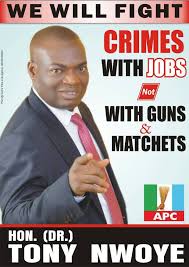
For APC, Dr Tony Nwoye is  seriously basking under the hefty political weights of the leading national party in Nigeria, APC. APC defeated PDP to produce the Nigerian president and majority of the governors.  If APC could produce the president and majority of the governors in Nigeria, what with this Lilliputian called Anambra. Nwoye believes he is positively advancing his flotilla towards a win. Many Anambra people think in the obverse: they see APC as a mere joke. In the minds of many voters in Anambra APC  is a painful infliction on NdIgbo. Since the inception of Muhammadu Buhari as president, there seems to be an upsurge of baleful acrimony running in the veins of NdIgbo all against the president and his winning party, APC. Again, the president seems cognisant of this ill will and intends to penalize NdIgbo for their untoward feeling. His body language and actions proved this: the Nnamdi Kanu incarceration, the continuous human rights abuse, the dissenting presidential speeches and the consummate brutality of Nnamdi Kanu's house invasion. What else? NdIgbo in Anambra believe that no Jupiter can manoeuvre victory for APC. Tony Nwoye's determined confidence in the inexorable machinations of APC will play out on November 18. Then Anambra NdIgbo will know whether the Baboon and the Monkey will be smeared in blood.

On another level IPOB is counting on their Social Media wrangle to declare that there will be no election come November 18. They have asked all Anambra people and Biafrans to stay at home that day. For some individuals, IPOB members are not just cynics, they are political atheists in the eyes of November 18.  They neither believe in APGA, PDP nor APC. Their kind of politics is radical: declare Biafra an independent State or nothing else. For a handful of opinionated Anambra, and indeed, NdIgbo elites, IPOB is a psychotic set-up that must be dismantled. Tobenna Okwuosa​, Chigozie Anarado, Colin Oguzie Uju​ and Ikeogu Oke  belong to this group. Yet for others IPOB is the inevitable backwash of a historic mistake, the aftereffect of a thoughtless politics and the underprivileged subordination by the devilish political aristocracy. Yours truly, Chike Ofili, and co belong to this later group. What can I say again? My people, November 18 is decisive; let us await it with a prophetic mind.


Okechukwu Nwafor is an Associate Professor of Fine Arts and the current Head, Department of Fine and Applied Arts in Nnamdi Azikiwe University, Awka.

Monday, February 13, 2017

Thanksgiving Service and the gospel according to Saint James Ibori

by Okechukwu Nwafor

Chief James Onanefe Ibori returned to a cheering crowd of his townsmen and women on February 4, 2016, after spending four and half years in a UK prison for criminal charges. Ibori's kinsmen staged a performative, flamboyant welcome for him and organised thanksgiving church service and reception ceremonies in his honour. During the church event which took place on 12 February 2016 at a Baptist Church in his hometown Oghara in Delta State, Ibori declared: "I am not a thief and cannot be a thief". In fact, according to Ibori, "Today is the day they say I should give testimony to God. For those that know me, you know that my entire life is a testimony itself and I have said it over and over again that my life is fashioned by God, directed by God, sealed, acknowledged and blessed by God and I believe that since the day I was born."

One, therefore, needs to rationalize Ibori's recent pronouncement, and its attendant aftermath, against a prevailing Nigerian psyche: first the fact that Ibori did not accept being a thief after serving a jail term for criminal offence, second the dominant Nigerian behaviourism of corruption, third the significance of God to Nigerian Christendom and for Ibori as a Nigerian politician. Indeed, this sounds like a lecture outline but it needs dissection.

Firstly, one must be alarmed that Ibori made such a statement in the first place. After a rigorous court process and an uncompromising verdict Ibori (himself pleaded guilty of the offence for which he) was convicted. It is, therefore, surprising, and at worst, embarrassing, that having fulfilled the terms of the crime in prison he would come back to deny the charges. The implication is that the moral bastion upon which human character is built is lacking in Ibori. It also means that his mind could possibly be suffering from a dangerous form of amnesia for which he totally forgot why he was held in the UK.

Secondly, there is nothing wrong in welcoming Ibori back home by his people. There is also nothing wrong in the affable and cheerful sympathy with which his people accepted him. Being away for so long eluded Ibori's loved ones of his affectionate presence. However, one becomes worried at the manner Ibori's people celebrate his return: effusive show of public festivity.  The tragedy of the Nigerian socialscape is such that there is no distinction between ignoble events and dignified events. The bash Ibori's return was treated to is utterly unnecessary. His return is not an enviable mark of achievement rather it is an ignoble anti-climax that should be treated with secluded cocktail. Such actions, obviously, sound bizarre in normal human reasoning for it means that plunderers are celebrated and should be applauded. What type of moral lessons are the Oghara people teaching to their younger generation?

Thirdly, we understand that the event was a thanksgiving church service. The question for those who were present during the event becomes: what was the subject of the pastor's sermon? One would have been able to provide a more sincere analysis had one been present during the church service. But even without being present during the service, the usual Nigerian style is for church ministers to eulogize wealthy corrupt politicians and church members, even when their source of wealth and livelihood is indisputably nefarious and malicious.  One is not surprised, therefore, that the Baptist Church in Oghara would celebrate Ibori for his 'steadfastness.' It is shameful indeed that many churches in Nigeria are mere spaces where atrocious credo of evil are legitimated. Oghara church cannot resist the compelling gospel according to Saint James Ibori. It is a gospel of double-dealing, of hypocrisy, of disturbing and arrogant religiousity and above all a gospel of visionless churching among a teeming Nigerian public.


Lastly, I want to understand the type of God some Nigerian Christians worship. Or do Nigerians have their own God who understands their capricious ways? Do Nigerians have a God who understands that even a thief should be celebrated and allowed to declare self-acclaimed innocence in the church, even after serving jail term; do Nigerians have a counterfeit God, who can be bought and asked to exculpate convicted criminals in church and he does so instantly; a God who usually invokes the case of the penitent thief beside Jesus on the Cross of Calvary to exonerate every Nigerian thieving politician and clear his road to heaven. Last word for Ibori, his people and the Baptist church in Oghara: There is God and they must attempt to discern the difference between the gospel according to James Ibori and the Gospel according to Saint James in the Holy Bible.  


Okechukwu Nwafor is an Associate Professor and Head of Department of Fine and Applied Arts, Nnamdi Azikiwe University, Awka. Email: charles21007@gmail.com       

Sunday, December 21, 2014

Nwanne’s creative oeuvres as social commentaries.


By Okechukwu Nwafor


Jimmy Nwanne’s works are eloquent testimonies to the crises that have befallen the entire human race. While his Diaspora sojourn may have promised a better living condition in far away Germany, his preoccupation with likely socio-economic issues in Nigeria is revealing of his passion to become a willing participant in a world torn apart by economic exploitation, political oppression and cultural degradation.  

The works, “Behind these walls” and “Lady with the veil” rendered in a somewhat realistic manner, make multiple statements about the world’s current threat. Whether they make remote allusion to the Middle East political crisis or a direct reference to the current threat posed by Boko Haram in the North East of Nigeria, Nwanne’s homeland, one can suggest that Nwanne has reconstructed the idea of ‘veils’ into a political battle for survival. While the works can serve as metaphors for an explicit critique of religion in a nation beleaguered by the tragedy of fundamentalism, the veiling could also suggest the silencing of dehumanised victims, whose narratives offer us an opportunity to revisit other dimensions of violence against women.  In these works, Nwanne seems to romanticise marginal life through a deft overlay of sombre colours, misty eyes and an aura of mystique around each physiognomic gaze. In both paintings the faces are broken into geometric shapes of colour, punctuated by interplay of silhouetted imageries built into the vertical veils.  Both the faces and the veils offer unending perspectives to a world of seemingly uneven topography; a battered landscape that defines our everydayness.

In the ‘Nation building Series’ Nwanne seems to accentuate the institutional constraints to thriving in Nigeria. He underscores the necessary ingredients needed to articulate new kinds of orientations towards nation building. These orientations suggest that nation building embodies two fundamental organs: the child and education. The pernicious effect of lack, of poverty, of deprivation can be substantially alleviated through proper investment in educating the child. If as the paradox goes that the child is father to the man, then Nwanne’s propositions are not merely idealizations but surely intend to resolve possible dangers of social and economic insecurity which an uneducated child may pose in the future. In ‘Nation Building II and III’, patches of colours progress in blocks of dark and bright hues around the entire figure. However, while the pencils and papers are highlighted, other figural elements are diminished. This may be for strategic reasons. On the other hand, the traditional ideal of classical beauty represented by the child figure points out the successful modernity of Nwanne’s style: strong extravagant colours signal Nwanne’s break with the radical conceptualism of the twenty first century. These works are strongly evocative of the emotional reality Nwanne has always been truthful to right from his student days at the Nnamdi Azikiwe University, Awka. Nwanne never shed his cultural specificity, despite the overarching influence of politics of difference in the West where he has been living and working. Not interested to transcend the questions posed by ‘Diaspora belongingness’ Nwanne pictured home as a constant site of return. He saw ‘home’ as a place where his creativity would make loud statements of sincerity and peace.

Perhaps, for Nwanne, the thought of home must have inspired the work “to the promise land’ where he seems to make audacious attempt to preserve his agency and increase the scope of his freedom. This work is very successful in the manner in which balance and harmony are blended into a cool ambience of movement. If Nwanne desired home so much as to return to Nigeria to show his new works, then time has come, according to West (1994:22), “for artists of the new cultural politics of difference to cast their nets widely, flex their muscles broadly, and thereby refuse to limit their visions, analyses, and praxis to their particular terrains. The aim is to dare to recast, redefine, and revise the very notions of... the mainstream”. Perhaps, Nwanne has revised this notion of ‘the mainstream’ to arrive at ‘the periphery’ thus reaching a new stage in his constant search for freedom. This freedom enabled Nwanne to return to Nigeria and open his creative vista to his own people. 


References

Cornel West (1994). “The New Cultural Politics of Difference” in Maurice Berger, Modern Art and Society, An Anthology of Social and Multicultural Readings. New York: IconEditions.


Okechukwu Nwafor holds a PhD in Visual History from the University of the Western Cape, Cape Town, South Africa. He was a former Research Associate in the Interdisciplinary Centre for the Study of Global Change (ICGC), University of Minnesota, USA. He is currently the Head, Department of Fine and Applied Arts, Nnamdi Azikiwe University, Awka, Anambra State. Email: penncils@yahoo.com


Behind these wall. Oil on canvas.

 Against All Odds. Oil on Canvas.


 Lady with veil. Oil on Canvas


Nation Building II. Oil on canvas.


To the promise land. Oil on canvas.

Despair. Oil on canvas.

Friday, November 28, 2014

Remembering Festus Iyayi

Below is an excerpt from my article published in today's Guardian: 
"That is an apt analogy and serves, as initially suggested, to construct a theory of gruesome power in Nigeria. That the convoy of governor of Kogi State, Mr. Idris Wada, rammed into the vehicle conveying Iyayi and some members of the Union to Kano, killing Iyayi on the spot, is not just a typical example where political leadership devolves into brutal domination; it also suggests the collapse of governance in Nigeria. It suggests that there is disconnect between political power and the masses in Nigeria, a vexing severance between the leader and the individual whereby the individual is constantly objectified in the everydayness of the politician. Being the second similar accident involving the convoy of Kogi State governor, it becomes clear that in Nigeria, leaders are mysteriously ferried across the land like awesome gods. Moving with the mechanism of fierce monsters, rocket-speed bravado, deafening sirens and ferociousness, leaders have literally emasculated the masses, stripping them of the last hope of amiable affinity and increasing their inherent hatred in the political class. This is actually a case of internal conflict among Nigerian masses eliciting the grand question of whether it is actually a good idea to constitute the governed in a country like Nigeria." Read more: http://www.ngrguardiannews.com/…/188259-nwafor-remembering-

Thursday, October 2, 2014

Vanguard’s Boko Haram reportage as propaganda

By Okechukwu Nwafor

It is necessary to cast our memories back to the Rwandan genocide of 1994 to understand more deeply the corrosive effect of acts of propaganda. In doing this we need to note very carefully how the Rwandan state framed genocide through the media. It is already well known that the Hutus’ willingness to take part en masse in the genocide had little to do with material calculations; it had everything to do with a ruthlessly efficient system of propaganda, and perhaps the misuse of Rwanda’s dangerous history to mystify the sources of social conflict in contemporary Rwanda.  

Historians eventually concluded that the perpetrators of Rwandan genocide understudied their history, and were skilful propagandists. Radio broadcast, for example, created an atmosphere of fear by repeatedly reporting that the Rwandan Patriotic Front (RPF), which comprised mainly of Tutsi refugees who came back from Uganda, were attacking unarmed civilians and wanted to wipe out the Hutu of Rwanda in a campaign of ‘ethnic purification’. This singular broadcast ignited the killing spree by the Hutus who massacred the Tutsis in their thousands.  In just 100 days, almost one million mainly Tutsi were murdered. It was estimated that about 70% of Tutsi population was exterminated in the genocide. It could be established that the search for a secure form of identity was not the sole or even the main cause of Rwandan genocide of 1994 but the government deployed this tendency to rally and coerce many Hutus to kill their neighbouring Tutsi, through acts of propaganda. The above analysis is very crucial in our understanding of what I have chosen to describe as ‘propaganda’ by the Vanguard Newspaper in their Boko Haram reportage. I have incontrovertible facts to back my proposition.

On 10 September 2014, while other newspapers bore captions promoting the gains made by the Nigerian military against Boko Haram, The Vanguard newspaper undermined these gains in their news. For example, while The Nation newspaper started its news article with, “Attempts by the insurgents to hit Vimtim, Chief of Defence Staff Air Chief Marshal Alex Badeh’s village, were repelled by troops”, Vanguard started with: “The military, yesterday, engaged the Boko Haram terrorists in a fierce battle at Vimtim....”  Obviously the levels of severity in the two reports are anything but incongruous. The words ‘attempts’ and ‘repelled’ as used by The Nation and the phrase “engage...in fierce battle’ as used by The Vanguard are disagreeable metaphors of calculated moderation and excessive distortion respectively. To further endorse their apparent bias, Vanguard went ahead and added, in the middle of the news: “We are in control of Bama, Michika, Mubi - Boko Haram”. This negativity was only found in the Vanguard report of that day and never in any other news print in Nigeria. The victory by the Nigerian military may have never been as potent as that of 10 September in the history of the fight against Boko Haram, yet Vanguard insisted on Boko Haram’s control over large territories. 

In a similar vein, Vanguard on its 15 September, 2014 news concerning the missing aircraft of the Nigerian army reports: “Sources told Vanguard that the (AA) anti-aircraft guns used by the Boko Haram insurgents may have been used by the terrorists on the aircraft.” This submission aims to terminate the least bastion of public faith in the Nigerian military. Not only that the major part of the 15 September report impugns the reigning narrative of victory by the Nigerian military, the journalistic mentality is conspicuously opposed to other news report on that same day such as The Nation newspaper’s which reads:  “Villagers in Lala State Development Area in Adamawa State claimed yesterday to have seen the wreckage. An administrative officer in Gombi Local Government Area of Adamawa State said villagers assisted a military search team in an effort to locate the plane after rumours that it crashed between Ngalga and Barda in Gabun ward.” The same Vanguard report also contradicts The Punch of the same 15 September which says: “An Air Force source said the plane was found through the help of some villagers.” Going through the entire report of The Punch, there is no indication of any tone of despondency as suggested by Vanguard reports. The question is why did Vanguard avoid a report suggesting that there were search efforts to locate the plane or why didn’t Vanguard show a slightest verisimilitude of hope expressed in the field as reported by The Nation, The Punch and others?  This is only if the Vanguard reporters are ever on the field to access primary news; does it mean that their journalists are armchair reporters who prefer to feed the public with secondary news especially as it concerns terror fighting in Nigeria? 

There is a problem in the Vanguard report on Boko Haram. It is obvious that their reporters are not happy with the glory the government enjoyed in the fight against terror, especially as it is credited to President Jonathan. Their terror reports resonate with an air of despair and pathetic vulnerability thus obliterating the slightest promise of credence the military would have enjoyed. They, thus, valorise Boko Haram’s deadly exploits. To prove this, on 20 September 2014, Vanguard reported thus:  “Boko Haram, which has seized swathes of territory in Borno and in neighbouring Yobe and Adamawa states, has been running short of food....Their insurgency has claimed more than 10,000 lives since 2009 and left more than 700,000 homeless”. The unfortunate part of this report is that it reminded us of the historical fatalities, in human numbers, of Boko Haram onslaughts without a veritable source that can be confidently cited.  While this may not be our worry, it is obvious that by amplifying the colossal human damage, it intends to degrade the military might and inject an air of discontent in the system. This is an act of propaganda. 


One can go on recounting such Vanguard’s unhidden predisposition towards the violent sect in almost all their reportage. While the general public is becoming discontented with this unwholesome journalistic tendency, it is necessary for the editorial board of Vanguard to have a rethink. Journalism must be balanced for it to make a meaningful impact in the society. Again, in critical and sensitive matters of national concern caution must be applied to avoid heating up the polity. This may suggest that the nature of reportage in our local fight against terrorism must be geared towards halting the spate of violence. This will enable Nigeria avert crisis similar to the Rwandan genocide which was obviously occasioned by the media campaign aptly crafted as propaganda by critical historians.


Dr Okechukwu Nwafor, a Senior Lecturer and former Research Associate at ICGC, University of Minnesota, is the current Head of Department of Fine and Applied Arts at the Nnamdi Azikiwe University, Awka.  Email: penncils@yahoo.com

Wednesday, August 13, 2014

John Odigie-Oyegun and Politics of Blame


http://www.ngrguardiannews.com/opinion/columnist/177998-nwafor-john-odigie-oyegun-and-politics-of-blame


IT is plausible to suggest that July 22, 2014 marked a penultimate date of an untoward dramatisation in Nigeria, especially for General Muhammadu Buhari. Then it is also even more plausible to suggest that July 23, 2014 would figure as the day of the unpleasant dramatisation proper especially, again, for Buhari and then for Mr. John Odigie-Oyegun, the national chairman of All Progressive Congress (APC). It is necessary to quickly substantiate the apparent analogies of these dates to a fatal dramatisation.
It was after the Nation newspaper, and several news media, reported on July 22, 2014 about Buhari's dismay at the spate of impeachments in Nigeria that an ominous cloud started to gather. "The gathering of dangerous cloud" is actually Buhari's own words during a public outing on that July 22, 2014. Then on July 23, 2014, in what seemed like the real gathering of this dangerous cloud, Buhari was attacked in a gruesome suicide bomb that claimed so many lives. That same day, Oyegun addressed newsmen in reaction to Buhari's attempted murder and "called on President Jonathan to institute a high powered probe to unravel the perpetrators of such heinous crimes, which left more than 75 persons killed and many more injured." The sic was as reported by Daily Times newspaper of July 24, 2014.
Mr. Oyegun sounded audacious. He urged Buhari's supporters and members of his party nationwide to remain calm, in the face of what he (Oyegun) describes as "obvious provocation". Oyegun's media verbalisation consistently charged Mr. President to get to the root of the bomb blast and unmask the perpetrators, with a warning that the bomb blast will not be "treated as one of the usual Boko Haram atrocities as there seems to be more to it than meets the eye." Oyegun made more pronouncements that may elicit a tinge of scepticism from a critical reader.
While we may not be in a haste to read Oyegun's speech as an impassioned submission from a vulnerable reactionary, we still reserve the right to interpret it as a deliberate act of incitement. In doing so we need to ask the question of why Oyegun would urge 'only' Buhari's supporters and members of his party to remain calm in the face of obvious provocation. The facts of this statement assume that only Buhari's supporters and APC members possess the emotional susceptibility that needed pacification in the face of violent attacks on the rest of Nigerians. The speech also suggests that agonising sorrow inflicted by terrorists is something that is painfully expressed 'only' by Buhari's supporters. In the end, instead of troubleshooting the violent engagement of terrorists, Oyegun's speech rather reinforces its divisive and unfeeling catastrophe. It imposes a vague distinction between the savage perpetrator and the vulnerable victim. This is a speech to many; a speech that rather polarises than it unites.
The remote signification of Oyegun's speech is still not farfetched: determined to construct an interface between savage degeneration of the system and the current administration, the speech fails to deliver on the mere precept of patriotic statesmanship. The speech is highly detrimental to the deep wounds of thousands of terror victims and their families, including the efforts of the present government to contain the insurgency. The speech has the potentiality to undermine genuine nationalistic efforts of terror fighters. In the same vein other APC leaders have spoken strongly against the twin bomb blast in Kaduna. Although some other party members such as the Senate President and his deputy, Ike Ekweremadu have also condemned the attack, one still needs to understand the reaction of APC leaders from a particular perspective of politics of blame.
In the politics of blame cheapest political points are scored at the expense of factuality; the frontiers of discontent are fructified rather than mitigated. The promising platforms that underpin compromise and negotiation are further punctured. In this politics, fault-finding knows no boundary and every little opportunity to smear the opposition is exploited to the fullest. This is exactly what happened when a group of APC governors vowed to hold President Goodluck Jonathan accountable for any further violent attack on Buhari. One therefore wonders whether this group is insinuating that the current attack on Buhari is masterminded by the President. One also wonders whether their speech is pointer to the fact that thousands of people slaughtered by Boko Haram over the past five years were less human than any one single individual in Nigeria.
If Buhari's attack must elicit such blemishes from a political party, why wouldn't other deadly attacks on innocent Nigerians elicit same reaction? Can we now say that terrorists have exceeded boundaries sanctioned by the opposition? Therefore politics of blame must be deployed to re-direct the misguided gaze of terrorists to the boundaries admissible by the opposition. My conclusion: Jonathan's name has suddenly become a major asset in APC's politics of blame. The deftness with which APC leaders apportion blame in the wake of most unwholesome happenings in Nigeria is probably one of the most unfortunate incidents in our political life, at least, over the past few years.
ThisDay 'Sunday Comment' July 27, 2014 describes the reaction of some APC leaders to the Buhari attack as "irresponsible and callous" and went further to argue that "finger-pointing and apportioning blames over terror attacks... have done as much to stoke the tension and feeling of insecurity in the country...." It seems blame-generating politicians now abound in APC and they seem to also believe that Jonathan must, and indeed deserves to, incur substantial political blame over untoward issues in Nigeria. Considering Oyegun's speech - and within the narrow discourse of APC's spurious blames - Jonathan's culpability is needlessly insinuated while his innocence is literally constructed as non-existent. This is unfortunate. It may not sound outrageous to conclude that in APC's politics of blame achieving compromise is as difficult as a Greek puzzle.
- Dr. Nwafor, a former Research Associate at ICGC, University of Minnesota, is a Senior Lecturer in Nnamdi Azikiwe University, Awka

Sunday, March 30, 2014

On Mother's Day Today.

Most often our plain interpretation quickly connects ‘mother’ to procreation. While motherhood is also about child bearing, it has far more remote implication. Whether a woman has a child, husband and partner may not really matter. To me she remains a mother as long as she has the ability to live up to the tenets of what I can ascribe to a ‘mother’. And these tenets are, but not limited to, a builder, a prime mover, a motivator, an organizer, an encourager. So if you are a woman out there, kindly accept my sincere acknowledgement and recognition of your disposition to transform lives, your constant craving for human rectitude, your insightful understanding of human foibles and above all your willingness to drive the course of human dilemma with the menfolk; your recognition, and acceptance, of the powerless in chauvinistic men also. I say many thanks to my wife who has lived up to the above responsibilities with love and equanimity, my mum whose outstanding hardwork and optimism elevated her family to the utmost realm of human endeavours, my mother-in-law whose positive strive and unyielding zeal constantly reassure the faith of her family, friends and associates. Indeed the list is endless, I say kudos to all the women I have come across for their astute perception of my hidden Achilles’ heels, for accepting my terms of an erratic emotional engagement that may, sometimes, shock! Ndi Nne Mama, I so kwa!

Thursday, March 20, 2014

Going for a South African Visa

http://www.ngrguardiannews.com/index.php/opinion/columnist/154100-nwafor-going-for-a-south-african-visa


By Okechukwu Nwafor

IT seems Nigerian Visa applicants have become adept at dancing to tunes of disgrace constantly handed over to them by officials of the VFS (South African Visa Applicant Centre) in Abuja. Officials here craft unsavoury song of humiliation determined to compel Nigerian applicants to dance to the tunes even at the risk of slumping from exhaustion. On Monday morning of February 10, 2014, I arrived at the South Africa Visa application centre in Abuja, Nigeria, at 9 a.m. to submit my Visa application and a security man at the gate pushed me back with a wave of hand saying “we have closed for the day.” Astonished, I pointed at the notice board and asked the security man to read the notice which says: “For submission:  8 a.m. to 3 p.m., Monday-Friday.”  But he instead commanded me, and few others hanging around the doorway, to move further away from the vicinity as strangers like us are not allowed to loiter around the building premises. His menacing gesticulation quickly sent us afar to a place that looks like a car park where I saw many touts lurking to defraud unwary clients. I felt pity for myself for being an object of embarrassment by this security man but also for accepting an apparent script of humiliation, ostensibly intended for just Nigerians. 
            One imagines the South African High Commission posting on her notice board in, say, Washington D.C. that Visa application submission is Monday to Friday from 8am to 3pm and then goes ahead to turn back prospective American applicants who have arrived on Monday at 9am to submit Visa application. Reason: they have closed for the day.  Obviously litigation would have woken them from a reverie, that is, only if they are daydreaming. 
            In Nigeria, the embassy is not under any reverie as this misleading notice has been there in Abuja for months. What is annoying is the impudence of foreign nationals on Nigerian citizens; the taken-for-grantedness of citizens; and this temerity by foreign nationals to consign Nigerian citizens to the waste bin of third-class creatures in their own nation, or elsewhere, seems a tacit acceptance that Nigerian Visa applicants are ignorant.  Or is the action a vengeful recourse to punish the desperate, young Nigerian hustlers seeking to escape to South Africa? 
            I decided to hang around the embassy until it is 3 p.m. Other applicants came and the security man told them, “we have closed for the day”. Perplexed at the naked effrontery with which the security man flouted the notice of 3 p.m. closing time, these applicants accepted their fate, believing that perhaps the Nigerian factor will play out and an inducement would magically open the door, just in the manner a remote-control would open a door. But it was not so. We all waited until 3 p.m. It then means that laws are only meant to be flouted with rudeness and disrespect in Nigeria, that is, if we assume that the embassy is situated on a Nigerian land and manned by Nigerian staff, as directed by South African authorities.  If a foreign embassy in Nigeria could not exercise common civility to keep a law it instituted and brazenly displays on its notice boards, one must worry that other laws written on papers and hidden beneath the grasp of ‘non-literate’ locals would receive more cruel violation. One worries what happens when locals even flout such laws.
            While some Nigerians may wish to travel to South Africa to commit crimes or break the laws of the land, many are travelling to South Africa to share with colleagues in professional knowledge, to engage colleagues in symbiotic professional collaboration and sometimes to impart superior knowledge to less endowed South Africans in certain sectors Nigerians may be adept. This is same for South Africans travelling to Nigeria. Life is a constant adventure in possibilities and no single race, individual, ethnicity, nationality is exempt from the dire stakes life has to offer.  But when a certain nation exhibits unequal and insensate show of power and superiority with their Visa, it becomes unfortunate. To prove this unequal show of power relations, and to prove that a superior power has the right to flout a law, and even defecate on top of your head, while the embassy happily flouts their own laws on the notice board, a certain Nigerian young man who answered call inside the embassy was harshly dealt with. He was rudely handed over to a security agent who sent him out of ‘Heaven’s gate,’ for the embassy gate ranks as ‘Heaven’s gate’. This young man was asked by the security man whether he did not see the notice that read: “Please switch off your phones”. This is akin to the manner in which I asked the security man at the gate: “Can’t you see the notice of 9 a.m. to 3 p.m., Monday to Friday?” and still he kept telling me that they have closed for the day, at 9 a.m.! 
          It is possible to argue that going for South African Visa in Nigeria is similar to a cow passing through the eye of a needle. Indeed, the processes are rigorous, breathtaking, humiliating, embarrassing and a seemingly impossible mission. As one young Igbo hustler whom I met at the embassy put it: “It seems more difficult than the processes of going to Heaven.” It sounds hilarious but after passing through the humiliating and embarrassing process, I tend to believe this young man that going for the South African Visa in Nigeria seems like an impossible mission.
           By the time I finished submitting my Visa application documents in Abuja on February 11, 2014, I felt exhausted, drained of any last energy. My eyes sunk deep and a vein shot through my forehead. Obviously, the Visa stress has added an awful wrinkle of age to my physical looks. I felt older in this embarrassing world of Visa application.  I also felt like one who has been relieved of some strange overload. I quickly dashed into a cool cuisine along the street and treated myself to a can of refreshing Ribenna and meat pie. Shortly, afterwards, I felt resuscitated. It then means that South African Visa process is suffocating.
             For me, I will go to South Africa again, but before then, the High Commissioner must have offered me a Permanent Residency Permit so I can avert another menacing brush with their security men who are trained to relish in the embarrassing statement: “We have closed for the day,” at 9a.m. even when the notice read 3 p.m. as closing time. 


•Dr. Nwafor is an AHP Postdoctoral Research Fellow at the Centre for Humanities Research, University of the Western Cape, South Africa and a Senior Lecturer in the Department of Fine and Applied Arts, Nnamdi Azikiwe University, Awka.